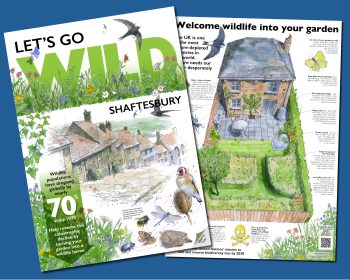

Sustainable Shaftesbury has produced a free illustrated poster to encourage the town’s residents to welcome wildlife into their gardens.Advice about simple steps to attract hedgehogs, insects, birds and butterflies to their backyards is also available as an interactive graphic. The project has been put together by the Council-backed Sustainable Shaftesbury committee and written by Angela King and Sue Clifford who, along with Roger Deakin, co-founded Common Ground, the creators of Apple Day. Ex-Sunday Times Graphics Editor, Gary Cook produced the illustrations to highlight that small, easy measures and changes to how we garden can help to reverse the 70% decline in biodiversity we are witnessing.
Over three quarters of the UK population are concerned about climate change and biodiversity loss and this poster, which features Shaftesbury’s star attraction Gold Hill, offers a range of solutions to combat it, many effort-free. For example, “Park the lawnmower for a while: welcome the wild flowers and listen to the grasshoppers. “Check for slow-worms, hedgehogs, frogs and other creatures before strimming or mowing.” Or “Let some of your garden go wild. Allow daisies, buttercups, forget-me-nots, clovers and mixed grasses to grow. Dandelion flowers are an important early food source for bumblebees and butterflies.” Other advice includes: “Plant fruit and nut trees, flowering shrubs with berries. “Share a tenth (tithe) of your produce from apples to red currants with creatures great and small.”
An interactive version of the leaflet can be seen here.
The poster and leaflets are available free from Shaftesbury Town Council and throughout Shaftesbury. Contact Brie Logan, Town Clerk at Shaftesbury Town Council for free use of the illustrations.
The group is also offering the artwork free to other councils to produce their own versions of the poster and help sow the seed of relaxed gardening and the positive impact it can make on wildlife populations, further afield.Sources:www.ons.gov.uk/peoplepopulationandcommunity/wellbeing/articles/threequartersofadultsingreatbritainworryaboutclimatechange/2021-11-05www.theguardian.com/environment/2022/oct/13/almost-70-of-animal-populations-wiped-out-since-1970-report-reveals-aoe